
Let's talk about what actually happens
When erectile dysfunction enters a relationship, both partners usually lock into one of two unhelpful stories. The person with a penis feels like they've failed. The partner with a vulva feels like they're not desirable enough. Both stories are wrong, and both kill the rest of what could still be really good sex.
Here's what a lemon clitoral vibrator actually does in this situation. It shifts the center of gravity away from penetration and toward what should have been the main event all along: your pleasure. That's not a consolation prize. That's the whole game.
Why penetration became the invisible goalpost
We've all internalized the same script. Sex means erection, erection means penetration, penetration means success. Everything else is foreplay (a word that literally means "before the real thing"). This framework is so baked into culture that most couples don't even notice they're following it until one piece breaks.
When ED shows up, that script falls apart. And instead of rewriting it, most couples just panic and try to fix the same old script faster.
The actual neurology is worth knowing. Erections require a very specific sequence: parasympathetic nervous system activation, blood flow, sustained attention, and zero performance anxiety. ED usually lives in that last part. The more pressure to perform, the less likely the body cooperates. It's a vicious loop.
But here's what's wild: clitoral orgasms don't require any of that. They require stimulation, arousal, and a body that feels safe enough to let go. A lemon vibrator handles the first part. Your partner's presence and attention handle the rest.
The real shift that needs to happen
Using a lemon clitoral vibrator with a partner who has ED requires one conversation before it requires anything physical. You have to separate two completely different things. "Your body isn't cooperating right now" is not the same as "I don't want you." Confusing them turns the vibrator into a Band-Aid over a confidence wound that needs actual talking.
Here's what that conversation sounds like:
"I love your body. I love being with you. What we're doing right now isn't working, and I want to try something different that gets me what I actually need. This isn't a backup plan. This is what I want."
That's not always easy to say, especially if you've spent years calibrating your pleasure around what your partner's body can do. But it's the foundation everything else sits on. Once that's clear, the mechanics become straightforward.
How the lemon vibrator actually changes the dynamic
A lemon clitoral vibrator like the Lem works differently than penetration. It's not a substitute. It's a completely different source of sensation that your partner can actively participate in, control, or simply witness. That participation is crucial because it keeps them involved instead of sidelined.
When your partner holds or controls the vibrator, they're not failing at something. They're doing something else entirely. There's a massive psychological shift in that reframe. Suddenly they're not anxious about an erection. They're focused on your responses, your pleasure, what makes you move. Performance anxiety dissolves because the "performance" is watching you, not penetrating.
Many couples find that this actually builds arousal for both of them. Your partner gets to feel competent. You get reliable, consistent stimulation. The pressure is off. And sometimes, when the pressure is actually off, erections happen anyway. But that becomes a bonus, not the point.
Timing, positioning, and the stuff nobody talks about
Start with a conversation about what you both want this to feel like. Does your partner want to hold the vibrator? Do they want you to? Do they want to be inside you while you use it? All of those are valid, and they create different experiences.
If your partner is holding or controlling the vibrator, you get two advantages. One: they're literally present and focused on your body. Two: they can adjust based on what they see and hear, which most people find deeply sexy.
If you're using it while they're inside you, the sensation for them changes. It's tighter, more stimulated, different than before. Some partners love this. Some find it too intense. You'll figure out what works.
Start with a lower intensity setting on patterns 1 or 2. Build from there. Your partner doesn't need to maintain an erection the entire time you're using the vibrator. That's the old script talking. They just need to be present and engaged. Rest when needed. Come back. There's no timeline.
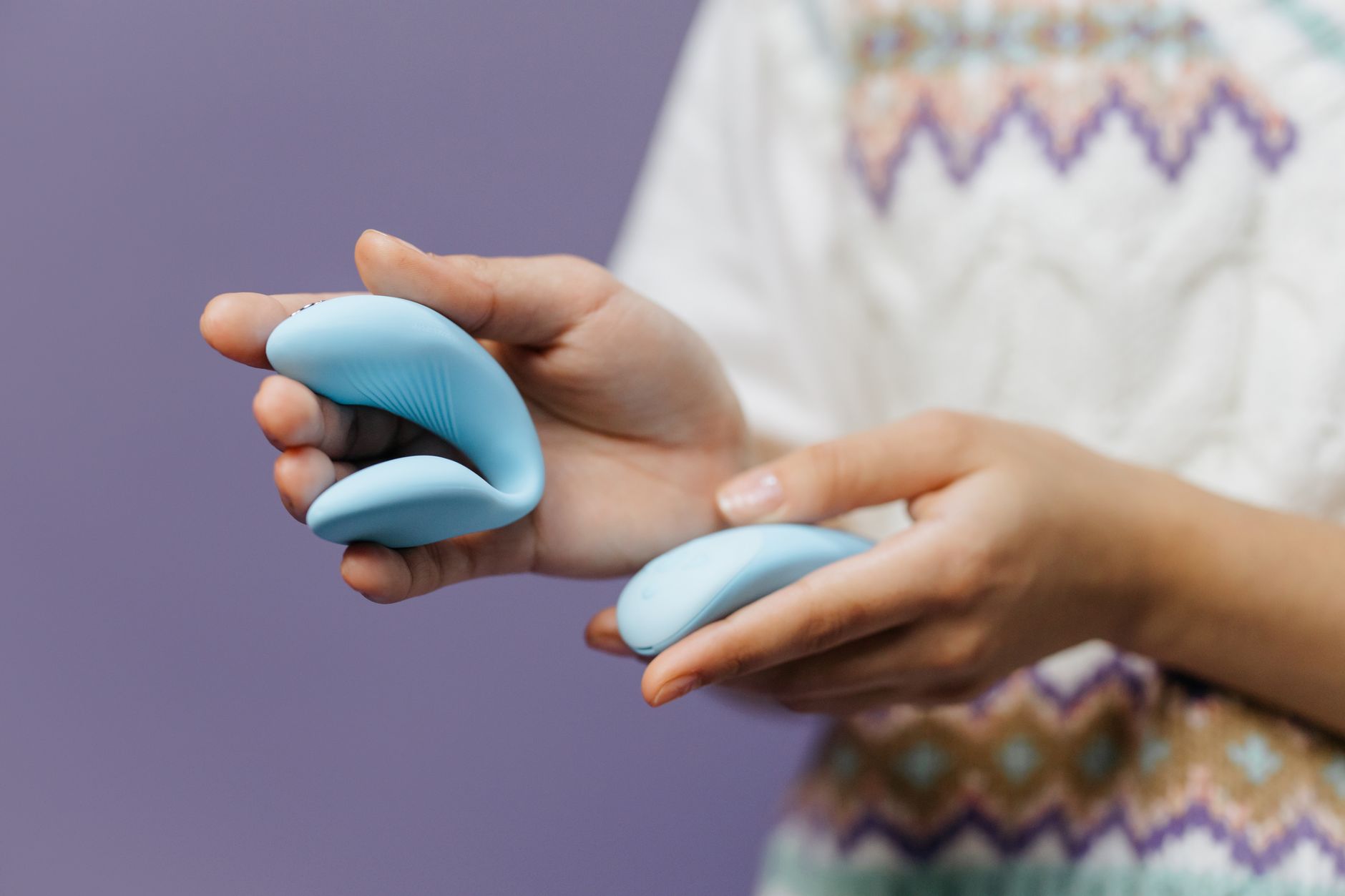
Photo by cottonbro studio on Pexels
The confidence piece nobody mentions
ED is as much about what happens in the brain as what happens in the body. When a partner says "I want you to use this vibrator with me," that's a confidence injection. You're not rejecting them. You're inviting them into something better.
For the partner with ED: you're allowed to feel relieved. You're allowed to feel sexy watching your partner. You're allowed to enjoy the fact that you're finally getting what they actually need instead of pretending penetration is still working when it isn't. That's not less. That's different, and different can be significantly better.
I've worked with so many couples who report that this shift saved their sex life. Not because a vibrator is magic, but because it forced the conversation they should have had years ago. "What do you actually want? Not what are we supposed to want. What do you want?"
The medical piece matters too
If ED is new or severe, see a doctor. It can signal cardiovascular changes or hormonal shifts that are worth knowing about. But even with treatment, a lemon clitoral vibrator isn't going anywhere. The conversation about your pleasure doesn't become less important once an erection is possible again. It becomes the baseline for good sex, regardless of what else is happening.
Some partners take ED medication and still use vibrators. Some use vibrators without any medication. Some use both and find that it's better than either alone. There's no "right" answer. There's just what feels good to both of you.
What this actually looks like
First time: talk. Tell your partner what you want. Ask what they want. Get curious instead of embarrassed.
Second time: start small. Lower settings. More time warming up. Your partner holds the vibrator. You focus on what feels good. They focus on you feeling good. Five to ten minutes. See what happens.
Third time: maybe something changes. Maybe your partner wants to try a different setting. Maybe they want you to take over. Maybe they want to be inside you while you use it. Adjust.
Everywhere after that: you've built a foundation where pleasure is the point, not penetration. ED might or might not resolve. Doesn't matter. You've already fixed the actual problem, which was thinking that one specific thing had to happen for sex to be good.
People also ask
Can we use a lemon vibrator if my partner's ED is psychological vs. physical?
Yes. In fact, the psychological piece often responds better because a vibrator removes the specific pressure point. When your partner isn't focused on maintaining an erection, arousal can actually happen. The physiology follows the psychology.
Will using a vibrator make my partner's ED worse?
It won't. What might happen is that your partner realizes penetration was never the thing that mattered in the first place. That's not worse. That's clarity. And clarity usually means better sex.
Should I wait to try a lemon vibrator until my partner gets treatment?
No. These aren't either/or. Some people benefit from ED treatment, medical or otherwise. But your pleasure doesn't have to wait for that. And honestly, having better sex right now might take the pressure off in a way that helps everything else.
What if my partner feels threatened by a vibrator?
That's a conversation, not a problem with the vibrator. If "a device for your pleasure" feels like a threat, that's usually about deeper stuff. Communication happens first, vibrator second. Frame it as "I want to feel better" not "you're not enough."
How do I bring this up without making it weird?
Say exactly that. "Hey, I want to try using a clitoral vibrator together. I think it could be really good for both of us. Can we talk about it?" That's it. No performance, no apology, no explanation you don't need to give. Your pleasure is normal. Asking for it is normal.
Can we use it during penetrative sex?
Absolutely. Lots of people do. Some do it internal and external simultaneously. Some use it on the clitoris while inside. The configuration depends on what you both want. Experiment and see.
What actually changes
Using a lemon vibrator when your partner has ED isn't a workaround. It's a recalibration. You're building sex around what actually feels good instead of around what's supposed to work. Most couples find that once they do this, they're not interested in going back to the old script, even if the old script becomes possible again.
Your pleasure matters. Not as a consolation when something else fails. As the central point. That's what a lemon clitoral vibrator does. It makes that impossible to ignore.
If you want to explore other ways to reconnect with your partner, read about how to use a lemon vibrator when reconnecting after long-distance or time apart. Or if you're navigating desire differences, check out how to use a lemon vibrator with your partner when desire mismatches create tension. Both cover similar ground from different angles.